Google Sandbox Explained — Do Aged Domains Skip It?
Muhammad Saad
Author
October 4, 2026
11 min read
New websites face months of slow rankings due to the Google Sandbox — but aged domains with clean histories can help you skip it. Here's what's real, what's hype, and what to check before buying.
The Waiting Game Nobody Warned You About
You build the website. You publish the content. You do everything the right way. And then you wait. Weeks pass, months pass, traffic stays flat, rankings barely move. The content is good. The strategy makes sense. The keyword research was solid. Yet Google seems to be completely ignoring everything you've done.
This experience is so common among new website owners that it has been given a name: the Google Sandbox. And whether you've heard the term before or you're encountering it for the first time, understanding what it actually means could be the most important thing you learn before launching your next online project — because it directly affects how fast you see a return on the time and money you put in.
What the Google Sandbox Actually Means
The Google Sandbox is not an officially confirmed feature. Google has never published documentation describing it. It's a term that emerged organically from the SEO community to describe a pattern that website owners and marketers have noticed and reported for well over a decade.
The pattern is this: new websites, regardless of how well built they are, tend to struggle to rank in competitive search results during the first several months of their existence. Content that should theoretically perform well based on quality, structure, and relevance simply doesn't gain the visibility it deserves. Then, at some point, something shifts. Rankings improve. Traffic starts arriving. The website begins behaving the way it always should have from day one.
That invisible waiting period — the gap between launching a website and seeing it rank consistently — is what the SEO community refers to as the sandbox.
The logic behind the sandbox makes sense once you consider what Google is actually trying to protect. Search results are valuable. Millions of people rely on them daily to find trustworthy information, compare products, make purchasing decisions, and solve real problems. If any new website could immediately rank for competitive terms simply by publishing content, the quality of search results would collapse almost overnight — flooded with thin, opportunistic sites racing to game rankings before anyone could verify whether they deserved to be there.
By applying additional scrutiny to new websites during their early months, Google creates a natural filter. It separates websites genuinely committed to building long-term value from those created purely to manipulate rankings quickly. In effect, the sandbox is Google's probationary period for new online presences — a way of saying "prove it" before handing over meaningful visibility.
How Long Does the Sandbox Last?
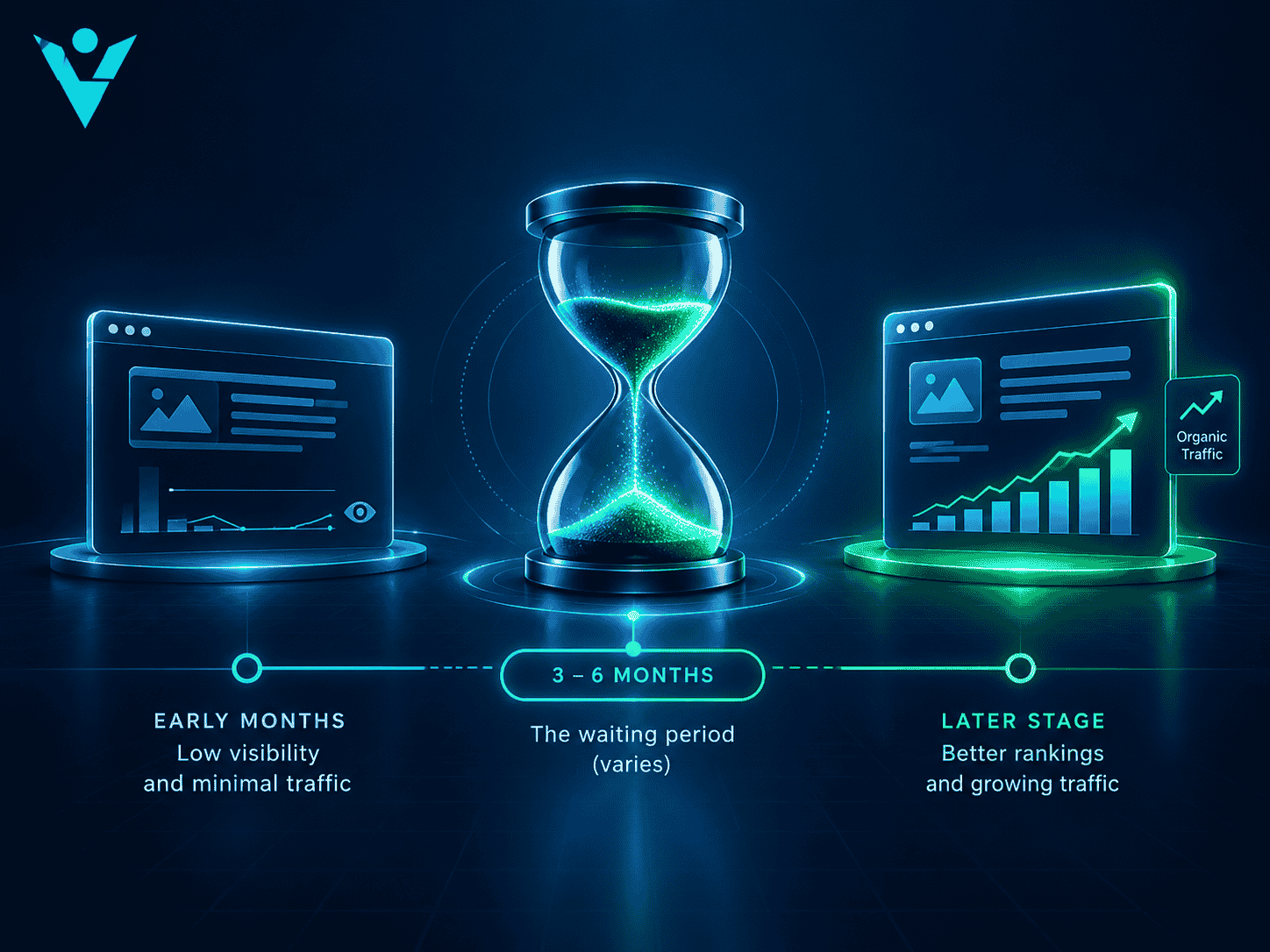
This is the question every new website owner wants answered precisely, and the honest answer is that it varies — sometimes significantly.
Moderately competitive niches: typically 3–6 months. Highly competitive industries (finance, health, legal, technology): often much longer — some owners report waiting over a year before content began ranking with any consistency
Factors That Influence the Timeline
Several variables affect how long a new website spends in the sandbox:
Niche competitiveness — the more saturated the space, the longer the wait
Content consistency — sporadic publishing signals lower commitment than a steady cadence
Backlink acquisition rate — links earned naturally, over time, build trust faster than sudden spikes
Overall trust signals — everything from technical SEO health to user engagement metrics feeds into how quickly Google begins treating the site as an established, credible source
What Happens During the Sandbox Period
During the sandbox period, a website isn't completely invisible. Pages may appear in search results for very low-competition, long-tail queries. Brand-name searches will usually still produce results. But the consistent, meaningful rankings that drive real organic traffic simply don't develop the way they would for an established website publishing the exact same content.
This is frustrating for owners who've invested real time and money into building something genuinely valuable. The content deserves to rank. The strategy is sound. But the domain itself hasn't yet earned the level of trust Google requires before rewarding it with consistent visibility in competitive search results — and no amount of on-page optimization can shortcut that trust-building clock.
Is the Sandbox Actually Real?
Google has never officially confirmed the existence of a sandbox filter. Senior figures at Google have, at various points, suggested that what website owners experience is simply the natural process of a new site earning authority and trust over time — not a deliberate suppression mechanism aimed at new domains.
From a practical standpoint, that distinction matters very little. Whether the sandbox is a specific filter or simply the natural consequence of starting with zero accumulated authority, the result for new website owners is identical: rankings are slow to develop, traffic takes longer to arrive than content quality would suggest it should, and patience becomes the most valuable tool in the early months of any project.
What the SEO community has consistently observed over many years is that this pattern is real, it affects virtually every new domain, and it tends to resolve itself at roughly the same point in a website's development — regardless of what we choose to call it.
Does Content Quality Speed Up the Process?
Publishing high-quality content consistently during the sandbox period does matter, but not necessarily in the way most people expect. Strong content during the early months is less about immediately breaking through the sandbox and more about positioning the website to perform strongly once the sandbox period ends.
Websites that use this window to build a solid content foundation, earn genuine backlinks, and establish clear topical authority tend to emerge with significantly stronger momentum than sites that published sporadically or chased shortcuts during the same timeframe. The sandbox period isn't wasted time for owners who use it correctly — it's foundation-laying time, even if it doesn't feel that way while you're in it.
Why Aged Domains Change This Equation Completely
This is where the sandbox conversation becomes directly relevant to one of the most practical decisions any website owner or digital investor can make.
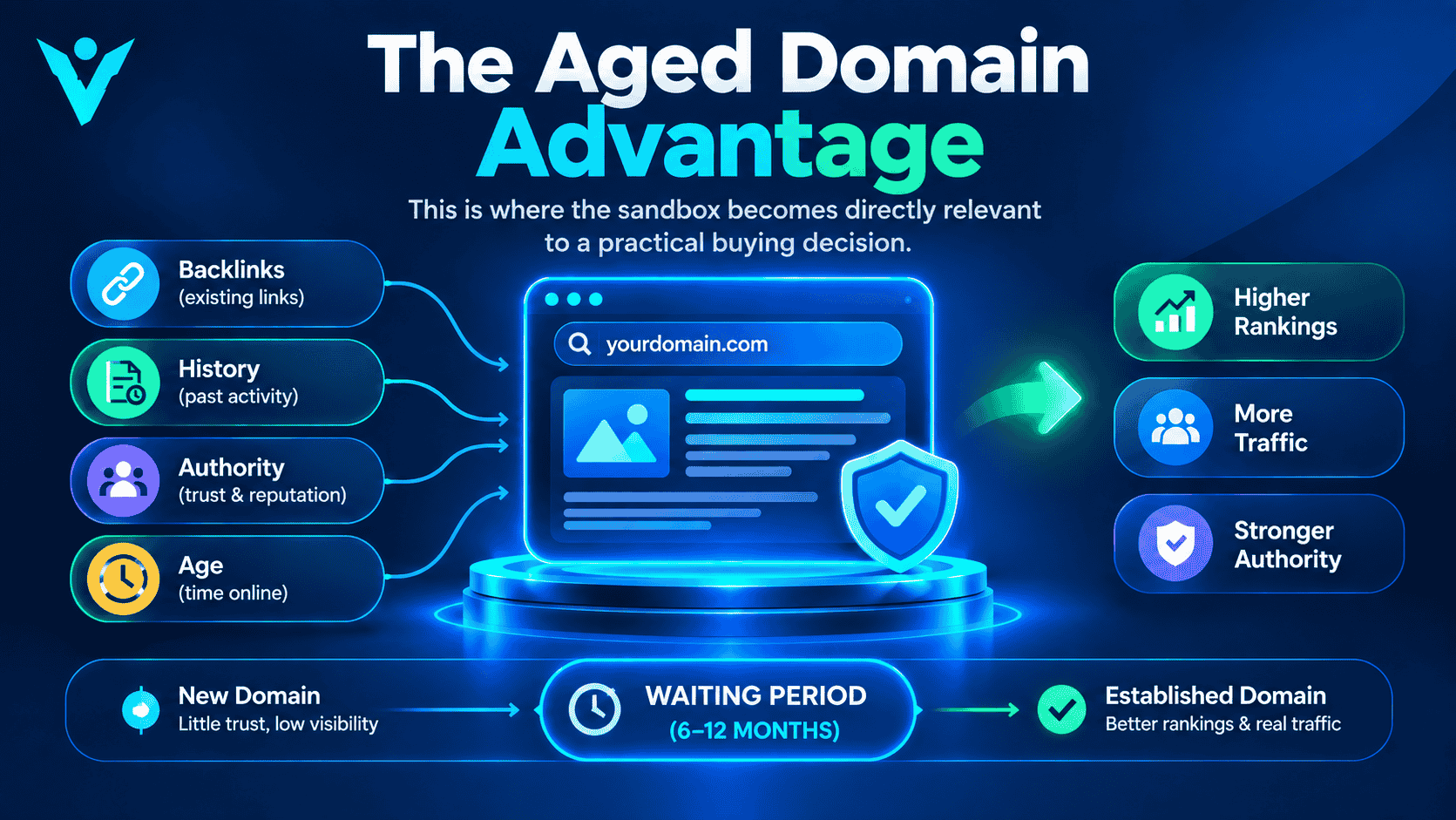
An aged domain that carried genuine activity during its previous life has already passed through the trust-building phase new domains must go through. Search engines spent years learning what that domain was about, who linked to it, what kind of audience it served, and whether its signals were authentic. That accumulated understanding doesn't disappear the moment a domain changes ownership.
When a new owner acquires a properly vetted aged domain and begins publishing content, they aren't introducing a stranger to the algorithm. They're continuing a relationship the domain already established. That distinction has enormous practical consequences for how quickly the new website begins developing meaningful search visibility.
Skipping the Waiting Period
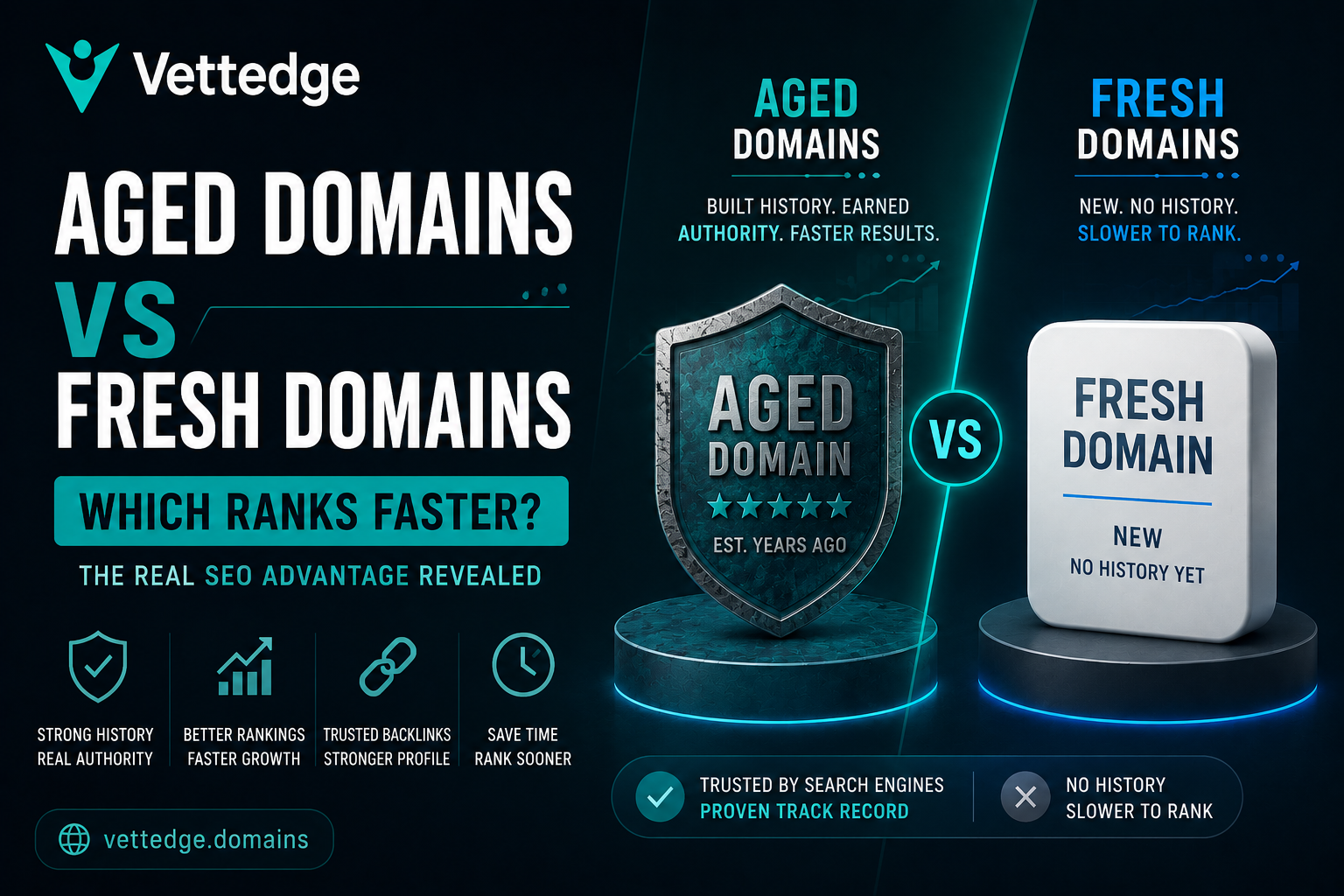
The most significant advantage an aged domain offers over a fresh registration isn't simply higher authority scores or larger backlink counts. It's time — specifically, the ability to skip or dramatically compress the sandbox period that costs fresh domain owners months of productivity and momentum.
A website launched on a quality aged domain in a relevant niche can begin seeing meaningful search visibility significantly faster than the same website launched on a fresh registration. Content published in the first month can rank in ways that would be flatly impossible for a new domain. The probationary period Google applies to unknown domains simply doesn't apply the same way to a domain that already carries an established history of credible signals.
For businesses that can't afford to wait six to twelve months for organic traffic to develop, for investors who need projects to monetize within realistic timeframes, and for anyone entering a competitive space where early visibility matters, this time advantage translates directly into real financial value.
Not Every Aged Domain Skips the Sandbox
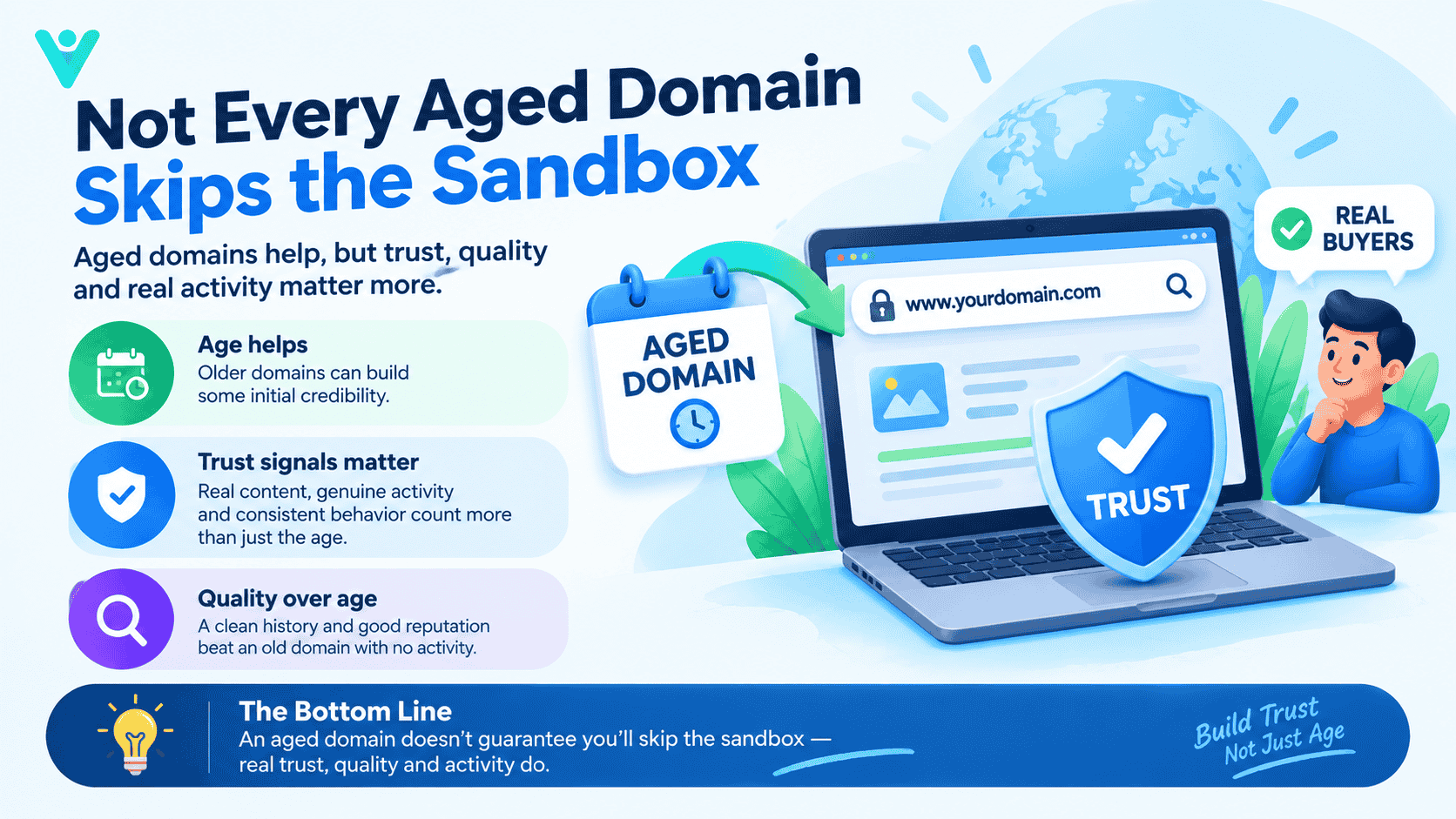
This is a distinction first-time aged domain buyers often miss, and it's worth addressing clearly. The sandbox advantage applies specifically to aged domains carrying clean, genuine trust signals from their previous life. A domain that existed for ten years but spent that time as a parked page, cycled through unrelated owners, or accumulated spammy backlinks doesn't carry the kind of established trust that lets a new website bypass the sandbox period.
Google doesn't reward age alone. It rewards the quality and authenticity of the signals that age produced.
A domain with ten years of genuine activity, consistent niche focus, and natural backlink development carries something real that transfers to a new owner. A domain with ten years of inactive or questionable history carries very little — regardless of what the registration date says.
What to Look for in an Aged Domain That Actually Skips the Sandbox
The aged domains most likely to deliver the sandbox-skipping advantage tend to share specific characteristics:
- A backlink profile that developed naturally over time from relevant, authoritative sources
- Historical content that maintained consistent topical focus rather than shifting between unrelated subjects
- Authority signals that are still active today, not just sitting in historical data
- No history of manipulation tactics that search engines have already identified and discounted
These aren't impossible standards to meet. Quality aged domains with these characteristics exist and are available in the marketplace — but they require proper evaluation before purchase, not blind trust that age alone delivers the advantage buyers are looking for.
The Practical Decision This Creates
Understanding the sandbox changes how you should think about starting any new online project.
A fresh domain is a legitimate choice for projects with patient timelines, long-term content strategies, and niches where early visibility isn't critical to success. Plenty of successful websites started exactly this way and built remarkable authority over time through consistency and quality.
An aged domain is the stronger starting point for projects where timing matters, competition is real, and the sandbox period represents a genuine cost — in lost opportunity, delayed revenue, or competitive disadvantage. The investment in a quality aged domain isn't simply buying a name. It's buying back the time the sandbox would otherwise take from you.
That time has real, quantifiable value. Weighing it against the cost of a quality aged domain is one of the clearest ways to understand why experienced digital investors consistently choose aged domains over fresh registrations when a project genuinely demands early results.
Final Thoughts
The Google Sandbox is real in every way that practically matters. Whether Google calls it a filter, a trust-building period, or something else entirely, the experience of launching a new website and waiting months for meaningful rankings is something virtually every fresh domain owner goes through.
Aged domains with genuine histories offer a legitimate path around that waiting period — not because they guarantee rankings, but because they arrive with the trust signals already established that fresh domains spend their first year trying to build.
Understanding that distinction, and making your domain decision accordingly, is one of the highest-leverage choices available at the start of any serious online project.